

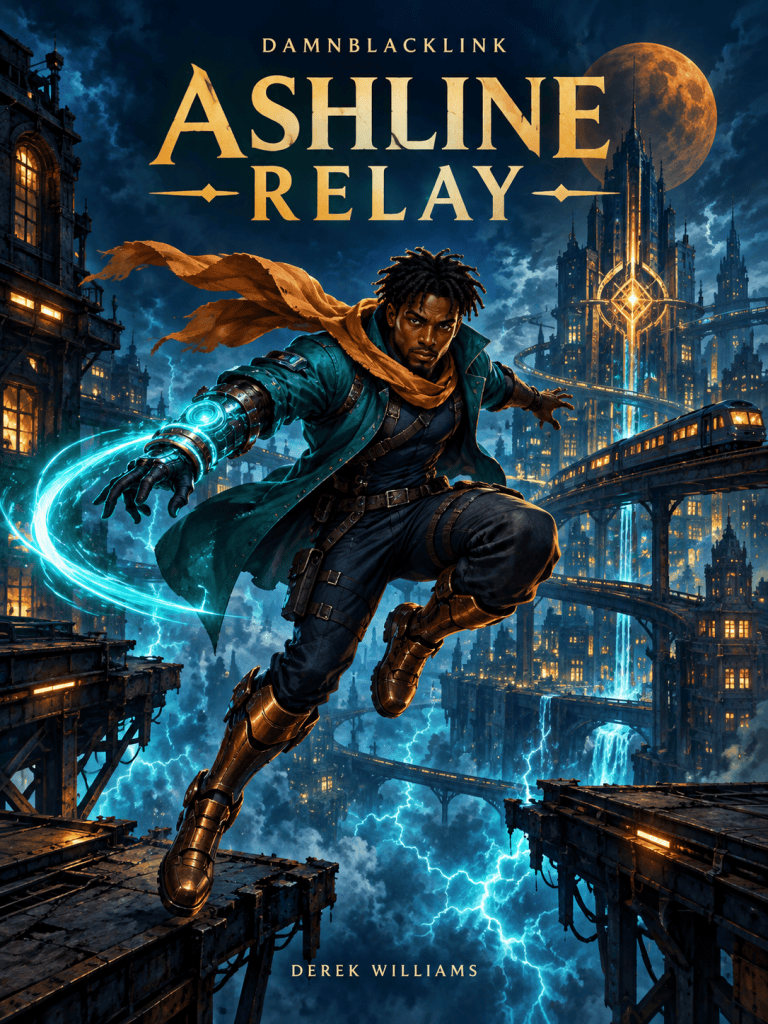
DamnBlackLink: Ashline Relay
A Black-led browser platformer prototype featuring precision jumping, dash movement, pulse combat, checkpoint respawning, and three relay objectives in a storm-swept transit district.
Project Changelog
v0.1.0 — Initial Playable Prototype
v0.1.0 — Initial Playable Prototype
October 16, 2026
The first playable release of DamnBlackLink: Ashline Relay, a browser-based 2D platformer set in an original storm-swept transit district. This version establishes the first level, core movement systems, combat, and relay-based progression.
Added
• A Black relay-runner protagonist with short locs, a teal field coat, amber scarf, copper boots, and a pulse gauntlet.
• A 4,300-pixel-wide side-scrolling level with platforms, storm gaps, and patrol drones.
• Three collectible relay cores that unlock the transit gate.
• A tracking camera, parallax city scenery, and code-drawn graphics.
• An on-screen HUD displaying armor, relay progress, dash availability, elapsed simulation time, and respawn count.
Movement and Combat
• Keyboard movement using WASD or the arrow keys.
• Variable-height jumping: release the jump button early for a shorter jump.
• Coyote time for a brief jump opportunity after leaving a platform.
• Jump buffering to register jump input shortly before landing.
• Directional dashing with a cooldown.
• Short-range pulse strikes.
• Patrolling drones that can be disabled with a pulse strike or dash.
• Three armor points and temporary invulnerability after taking damage.
Progression and Game States
• Checkpoint beacons that restore armor and save the respawn position.
• Respawning after falling into the storm or losing all armor.
• Relay activation and defeated drones retained after respawning.
• A locked exit that opens only after all three relays are restored.
• A completion screen showing elapsed simulation time and respawns.
• A restart option that resets the level and progress.
• Automatic pausing when the game loses focus or the browser tab becomes hidden.
Controls and Interface
• Play/Resume and Restart controls.
• Basic on-screen pointer controls for movement, jumping, dashing, and striking.
• Visible mission instructions and status messages.
• Responsive canvas display scaling.
Technical Foundation
• Built with JavaScript, HTML Canvas, and CSS.
• Fixed-step simulation running at 120 updates per second, with capped catch-up work after frame stalls.
• Rectangular collision detection for platforms, enemies, collectibles, and checkpoints.
• No external libraries, asset downloads, installation, or build tools required.
Packaging
• Included the complete game source and local setup instructions.
• Added an optional Node.js logic-test script and a manual browser-testing checklist.
• Included project cover artwork and publishing drafts.
Validation
• JavaScript syntax validation passed.
• All 12 automated logic checks passed.
• Checks covered movement-related logic, collisions, relay persistence, checkpoints, combat, gate unlocking, and resetting.
Known Limitations
• Initial graphics use simple geometric shapes and procedural effects.
• Automated checks use a mocked browser environment and do not verify actual browser rendering or complete playthroughs.
• End-to-end browser testing and real mobile-device testing were pending at this release.
• The working title had not undergone trademark clearance.
• This release is an early prototype, not a finished game.